Best Audio Interface for Phone (2026): 5 Picks Compared
Updated Oct 24, 2026 · By  Jonah Mercer · Ranked from listed specifications · How we rank
As an Amazon Associate I earn from qualifying purchases. Buying through the Amazon links on this page costs you nothing extra. Full disclosure
The IK Multimedia iRig Pro I/O leads this list as Best Overall, with 24-bit and 96 kHz recording, an XLR and Hi-Z combo input and Lightning, USB-C and USB-A cables in the box. If you want a Lightning-only interface for 3.5mm microphones, the Saramonic SR-EA2D is the pick, with a 3.5mm headphone output for real-time monitoring.
The picks at a glance
Which one should you buy?
- Musicians who want an XLR and Hi-Z combo input: IK Multimedia iRig Pro I/O audio interface See pick 1More picks: Best Audio Interface for XLR
- Streamers who want Auto Level Mode for broadcasting: Shure MVX2U XLR-to-USB Audio Interface with Headphone See pick 2
- iPhone users who want a Lightning audio interface: Saramonic SR-EA2D Lightning Audio Interface with 3.5mm See pick 3More picks: Best Audio Interface for iPhone
- Guitarists who want a 24-bit and 96 kHz guitar interface: IK Multimedia iRig HD X Guitar Audio See pick 4More picks: Best Audio Interface for Guitarists
- Creators who want adaptive gain control for instruments: Synido A20 Portable USB-C Audio Interface for Guitar See pick 5
Want the full range? Best Audio Interface ranks the top audio interfaces for every buyer, or browse all 59 guides.
The 5 picks, ranked
1Best Overall
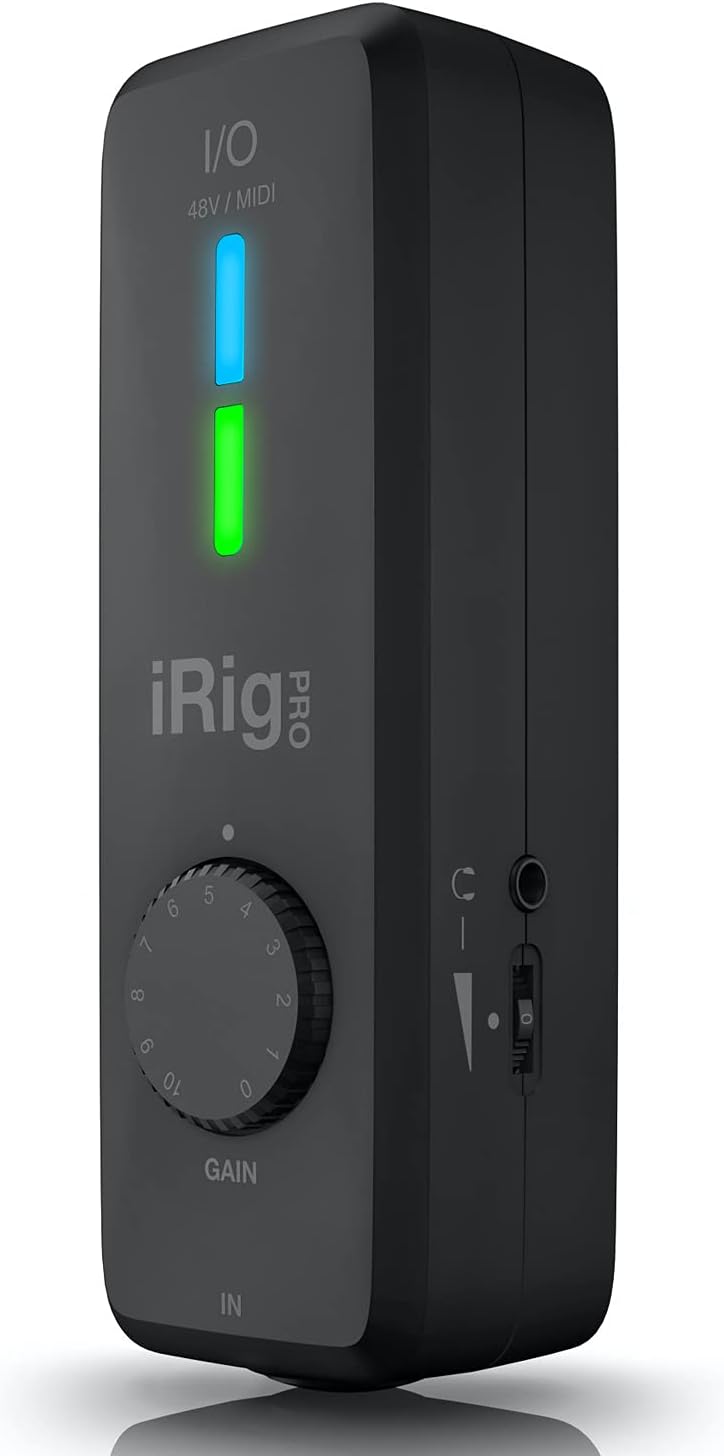
IK Multimedia iRig Pro I/O audio interface
- Inputs: 2
- Max sample rate: 96 kHz
- Bit depth: 24-bit
- 48V phantom power
- 1-year warranty stated
It earns Best Overall with 24-bit and 96 kHz recording, an XLR and Hi-Z combo input and 48V phantom power.
Who it suits
- Musicians who want an XLR and Hi-Z combo input
- iPhone users who want Lightning, USB-C and USB-A cables
Skip it if
- You want recording above 96 kHz
- You want more than 2 inputs
The combo input takes an instrument or a microphone, with 48V phantom power for condenser microphones and MIDI In and Out for controllers and keyboards. A headphone jack gives direct monitoring, and the box holds Lightning, USB-C and USB-A cables. It weighs 0.2 lb, works with iPhone, iPad, Mac, iOS and PC, and carries a 1-year warranty.
2Runner-Up

Shure MVX2U XLR-to-USB Audio Interface with Headphone
- Inputs: 1
- Max sample rate: 48 kHz
- Bit depth not stated in the listing
- 48V phantom power
- 2-year warranty stated
It holds Runner-Up with an XLR-to-USB design, a 60dB preamp and 48V phantom power.
Who it suits
- Streamers who want Auto Level Mode for broadcasting
- Singers who want a 3.5mm headphone jack for monitoring
Skip it if
- You want recording above 48 kHz
- You want more than 1 input
The XLR-to-USB interface turns any XLR microphone into a USB source, with up to 60dB of gain and 48V phantom power. A 3.5mm headphone jack gives zero-latency monitoring, and dual mounting options plug it onto the microphone or inline with an XLR cable. A 1m USB-C cable comes in the box, and the unit weighs 0.2 lb with a 2-year warranty.
3Also Great

Saramonic SR-EA2D Lightning Audio Interface with 3.5mm
- Inputs: 2
- Max sample rate: 48 kHz
- Bit depth not stated in the listing
- 48V phantom power not stated in the listing
- 2-year warranty stated
It holds Also Great with a Lightning connector, a 3.5mm mic input and a 3.5mm headphone output.
Who it suits
- iPhone users who want a Lightning audio interface
- Creators who want 3.5mm TRS or TRRS mic inputs
Skip it if
- You want an XLR microphone input on the interface
- You want a USB-C connector for an Android phone
The low-profile interface mounts on the device and takes 3.5mm microphones with TRS and TRRS compatibility and plug-in power. A 3.5mm headphone output gives real-time monitoring and playback. It plugs into Lightning iPhones and iPads with no drivers needed, and it carries a 2-year warranty.
4Also Great

IK Multimedia iRig HD X Guitar Audio
- Inputs: 1
- Max sample rate: 96 kHz
- Bit depth: 24-bit
- 48V phantom power not stated in the listing
- 2-year warranty stated
It holds Also Great with 24-bit and 96 kHz guitar recording, an onboard tuner and an Amp output.
Who it suits
- Guitarists who want a 24-bit and 96 kHz guitar interface
- Players who want AmpliTube and TONEX apps in the box
Skip it if
- You want more than 1 input
- You want an XLR microphone input on the interface
The guitar interface records at 24-bit and 96 kHz with an onboard digital tuner and a multi-LED gain indicator. A headphone output gives direct monitoring, and a dedicated Amp output offers FX or THRU settings. It comes with AmpliTube and TONEX apps, runs bus-powered with no external power source, and carries a 2-year warranty.
5Also Great

Synido A20 Portable USB-C Audio Interface for Guitar
- Inputs: 2
- Max sample rate: 96 kHz
- Bit depth: 24-bit
- 48V phantom power not stated in the listing
It holds Also Great with 24-bit and 96 kHz recording, adaptive gain control and a wireless backing track switch.
Who it suits
- Creators who want adaptive gain control for instruments
- Streamers who want a wireless backing track from a second phone
Skip it if
- You want recording above 96 kHz
- You want more than 2 inputs
The interface records at 24-bit and 96 kHz with adaptive gain control for different instruments. A one-touch wireless switch connects a second phone for a wireless backing track, and loopback and monitor functions support live streaming. A USB-C interface connects to a phone or computer, charges the phone during live broadcasts, and stores its cable in the body.
Side by side
| Product | Inputs | Mic preamps | Outputs | Max sample rate | Bit depth | 48V phantom power | Software named | Weight | Warranty |
|---|---|---|---|---|---|---|---|---|---|
| IK Multimedia iRig Pro I/O audio interface | 2 | Not stated | Not stated | 96 kHz | 24-bit | Yes | Not stated | 0.2 lb | 1-year |
| Shure MVX2U XLR-to-USB Audio Interface with Headphone | 1 | Not stated | Not stated | 48 kHz | Not stated | Yes | Not stated | 0.2 lb | 2-year |
| Saramonic SR-EA2D Lightning Audio Interface with 3.5mm | 2 | Not stated | Not stated | 48 kHz | Not stated | Not stated | Not stated | Not stated | 2-year |
| IK Multimedia iRig HD X Guitar Audio | 1 | Not stated | Not stated | 96 kHz | 24-bit | Not stated | Not stated | Not stated | 2-year |
| Synido A20 Portable USB-C Audio Interface for Guitar | 2 | Not stated | Not stated | 96 kHz | 24-bit | Not stated | Not stated | Not stated | Not stated |
How we ranked these audio interfaces
Every pick has at least 100 customer ratings on Amazon and a listing with real specifications. The order mixes two things: how each model compares on the specs below (higher share of the best value in this group scores more), and how widely it is bought. The spec score runs from 9.0 to 9.8 and only compares these picks with each other. A spec the listing does not state is left out and the other specs are re-weighted; a listing with fewer than 2 stated specs is scored at half. We do not test gear in person. Full method.
- Inputs weight 3
- Mic preamps weight 2
- Outputs weight 1
- Max sample rate weight 2
- Bit depth weight 1
- 48V phantom power weight 2
Buying advice: audio interface for phone
Match the connector to your phone
The connector decides whether the interface plugs into your phone at all. The iRig Pro I/O ships with Lightning, USB-C and USB-A cables, the Saramonic uses Lightning only, and the Synido uses USB-C. The Shure uses USB-C for Mac and Windows. Check your phone port before you buy, since a Lightning interface and a USB-C phone do not mix.
Count inputs before you choose
Inputs decide how many sources you record at once. The iRig Pro I/O, the Saramonic and the Synido each hold 2 inputs, while the Shure and the iRig HD X each hold 1 input. If you record a microphone and an instrument together, pick 2 inputs. If you record one source at a time, 1 input is enough.
Check phantom power for condenser microphones
Condenser microphones need 48V phantom power from the interface. The iRig Pro I/O and the Shure both carry 48V phantom power for condenser microphones. The Saramonic uses plug-in power for 3.5mm microphones instead. Check your microphone type before you choose, since a condenser microphone without phantom power stays quiet.
Frequently asked questions
Can I record an XLR microphone on a phone?
Yes, with the right interface. The iRig Pro I/O takes an XLR microphone through its combo input, and the Shure turns an XLR microphone into a USB source. Both carry 48V phantom power for condenser microphones.
Do I need drivers for a phone interface?
Not always. The Saramonic plugs into Lightning iPhones and iPads with no drivers needed. Check the interface you choose, since driver needs vary by model.
What sample rate do I need for phone recording?
It depends on your project. The iRig Pro I/O, the iRig HD X and the Synido record at 24-bit and 96 kHz, while the Shure and the Saramonic reach 48 kHz. Higher rates give larger files, so match the rate to your project.
Can I monitor myself while recording on a phone?
Yes. The iRig Pro I/O, the Shure, the Saramonic and the iRig HD X each have a headphone output for monitoring. The Synido adds loopback and monitor functions for live streaming.
Gear that goes with it
 Best Condenser MicTop pick: Rode RØDE NT1 Signature Series Studio Condenser Microphone
 Best Studio MonitorsTop pick: Yamaha HS4 Powered Studio Monitor in Black
 Best Mixing HeadphonesTop pick: beyerdynamic DT 770 Pro Studio Headphones
 Best XLR CableTop pick: Cable Matters 2-Pack Premium XLR to XLR
More audio interfaces guides
Specifications and availability come from each Amazon listing on Oct 24, 2026 and can change. Check the listing before you buy.