How to Set Up a Condenser Microphone
Updated Nov 13, 2026 · By  Jonah Mercer · Editorial policy
As an Amazon Associate I earn from qualifying purchases. Buying through the Amazon links on this page costs you nothing extra. Full disclosure
A condenser microphone needs 48V phantom power from an interface or mixer, sent up the same XLR cable that carries its signal. Mount the mic in its shock mount, connect the XLR cable, switch on 48V with the gain down, then raise the gain and set the pad and high-pass filter for the source.
Mount the mic in its shock mount
Screw the shock mount onto the mic stand and seat the microphone in it so the mount holds the mic without touching the body. The AT2035 ships with a custom shock mount, the Shure SM4 kit includes one, and the Tascam TM-80 includes an elastic shockmount and a tabletop stand. Tighten the stand so the mic stays where you put it.
Connect the XLR cable
Plug an XLR cable into the base of the microphone and into the interface or mixer input. The Tascam TM-80 ships with a six-foot XLR cable in the box. Keep the cable clear of the stand legs so a pull on the cable does not drag the mic off the stand.
Switch on 48V phantom power
Turn the input gain all the way down before you switch anything on. Connect the microphone first, then switch on 48V phantom power at the interface or mixer and wait a few seconds before you raise the gain. When you finish, turn the gain down and switch 48V off before you unplug the cable.
Set the pad and the high-pass filter
Use the pad when the source is loud enough to distort, and leave it off for quieter sources. The AT2035 has a switchable 10 dB pad and an 80 Hertz high pass filter, and the AKG P120 has a -20 dB pad and a 300 Hertz bass cut filter. Switch the filter on to cut low rumble from the room before you record.
Face the front of the mic
A cardioid microphone hears most from the front and least from the sides and rear, so speak or play into the front of the mic. All four microphones here use a cardioid pattern. Keep noise sources behind the mic, and keep the mic away from walls that bounce sound back into it.
What you need

Audio-Technica AT2035 Cardioid Condenser Microphone
A cardioid condenser microphone with an XLR output, a custom shock mount, an 80 Hertz high pass filter and a 10 dB pad.
- Shock mount included
- Polar pattern: Cardioid
- 2 year warranty stated

Shure SM4 XLR Studio Condenser Microphone Kit
A cardioid condenser microphone kit with a detachable magnetic pop filter, a shock mount and a zippered carrying case.
- Shock mount included
- Pop filter / windscreen
- Polar pattern: Cardioid
- 2-year warranty stated

AKG Pro Audio P120
A cardioid condenser microphone with an XLR connector, a -20 dB pad and a 300 Hertz bass cut filter.
- Polar pattern: Cardioid
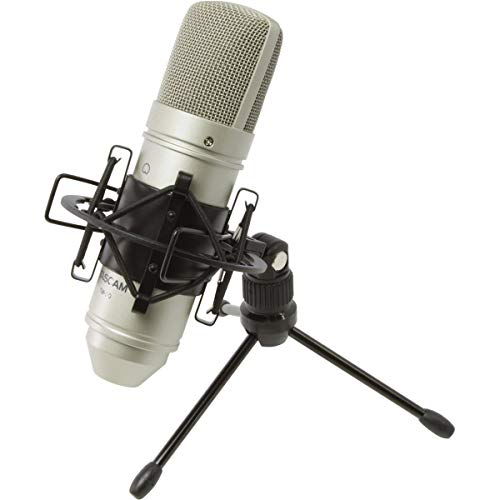
Tascam TM-80 Large Diaphagm Condenser Microphone
A cardioid condenser microphone with an 18mm aluminum diaphragm, a tabletop stand and a six-foot XLR cable.
- Shock mount included
- Polar pattern: Cardioid
- 1-year warranty stated
- 0.5 lb, the lightest here
These come from our ranked list Best Professional Condenser Mic, which compares them spec by spec.
Frequently asked questions
Does a condenser microphone need phantom power?
Yes, if it is a condenser microphone with an XLR output. The interface or mixer sends 48V up the XLR cable to power the mic. A dynamic microphone does not need it.
What is the pad on a condenser microphone for?
The pad lowers the signal from a loud source so the microphone does not distort. The AT2035 has a 10 dB pad, and the AKG P120 has a -20 dB pad. Leave the pad off unless the source is loud.
Why does my condenser microphone pick up room noise?
A cardioid microphone still hears sound from the room, just less from the sides and rear. Speak into the front of the mic, move noise sources behind it, and switch on the high-pass filter to cut low rumble.
Do I need a pop filter with a condenser microphone?
A pop filter cuts the puffs of air from hard consonants before they hit the mic. The Shure SM4 kit includes a detachable magnetic pop filter, and its internal pop filter also cuts plosive sounds.
Ranked condenser microphones lists
More how-to guides
Product details come from each Amazon listing and can change. Check the listing before you buy.