Bookshelf vs Floor Standing Speakers
Updated Nov 12, 2026 · By  Jonah Mercer · Editorial policy
As an Amazon Associate I earn from qualifying purchases. Buying through the Amazon links on this page costs you nothing extra. Full disclosure
Bookshelf speakers are speakers that sit on a shelf or a stand, while floor-standing speakers are tall cabinets that stand on the floor. The difference is size: a floor-standing cabinet holds larger drivers, while a bookshelf speaker takes up less space. Your choice comes down to the space you have and the low notes you want.
What sets each type apart
A bookshelf speaker is a compact cabinet made to sit on a shelf, a desk or a speaker stand, with its drivers in a small box. A floor-standing speaker is a tall cabinet that stands on the floor and gives its drivers more space inside the box. That size gap is the whole comparison: it shapes where each type goes, how many drivers it holds, and whether it needs a separate amplifier.
Size and placement in your space
Measure the spot where the speakers will sit before you choose. A bookshelf speaker needs a sturdy shelf or a stand at ear height, plus space behind it for cables. A floor-standing speaker needs floor space and room to stand clear of the wall, since it is a tall cabinet. If the space is tight, a bookshelf pair leaves more of the room free.
Drivers and low notes
A speaker driver moves air to make sound, and a larger driver moves more of it, so cabinet size shapes how low a speaker reaches. The bookshelf speakers here use 4-inch woofers on the Edifier pair and a 5.25-inch woofer on the Klipsch R-50PM, with a 13mm silk dome tweeter on the Edifier pair. A floor-standing cabinet has room for larger woofers and more drivers, so it can cover low notes without a separate subwoofer.
Powered or passive, and what plugs in
The speakers here are powered, so each pair plugs into a power outlet and takes a line or Bluetooth input with no separate amplifier. The Edifier R1280DB and R1280DBs take optical and coaxial inputs, and the R1280DBs adds a subwoofer output for a separate subwoofer. A passive floor-standing pair needs a separate amplifier or receiver, so check what the speaker needs before you buy the rest of the setup.
Which type fits your space
Pick bookshelf speakers when the space is small or the speakers must sit on a shelf or desk, and add a subwoofer later for more low notes. Pick floor-standing speakers when you have floor space and want a tall cabinet that covers low notes on its own. Either way, check the inputs on the back of the speaker against the outputs on your TV or computer before you buy.
What you need

Edifier R1280DB Powered Bluetooth Bookshelf Speakers
A powered bookshelf pair with Bluetooth, optical and coaxial inputs, a 4-inch bass driver and a 13mm silk dome tweeter, with side-panel bass and treble controls and a remote.
- Power: 42 W
- Bluetooth
- 2-year warranty stated
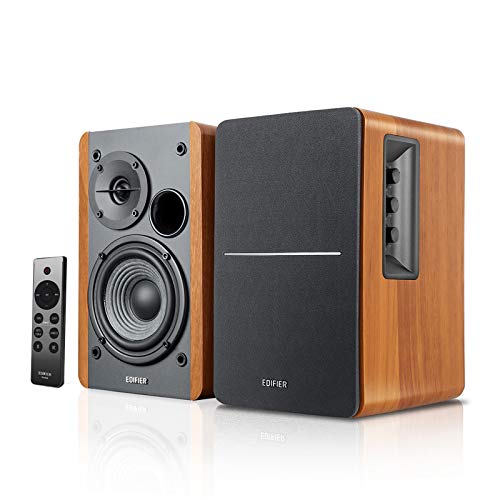
Edifier R1280DBs Active Bluetooth Bookshelf Speakers
A powered bookshelf pair with Bluetooth 5.0, optical and coaxial inputs, a subwoofer output with a built-in crossover, and side-panel bass, treble and volume controls.
- Power: 42 W
- Bluetooth
- 2-year warranty stated
- 10.8 lb, the lightest here
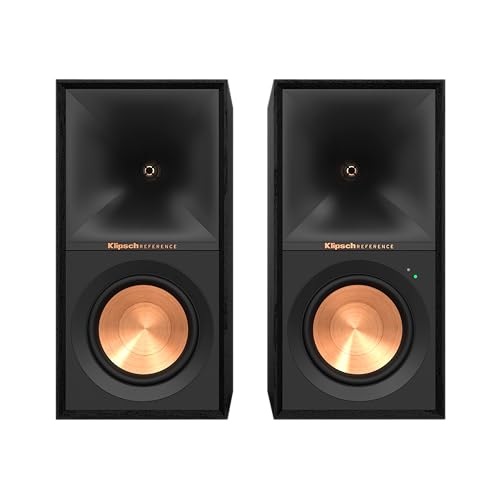
Klipsch R-50PM Powered Speakers with 5.25" Woofers
A powered bookshelf pair with 5.25-inch copper-spun woofers, 1-inch aluminum LTS tweeters and Tractrix horns, that plugs into a power outlet with no separate amplifier.
- Woofer size: 5.25 in
- Bluetooth
- 3-year warranty stated
These come from our ranked list Best Bookshelf Speakers, which compares them spec by spec.
Frequently asked questions
Do bookshelf speakers need a subwoofer?
Not always. The Edifier R1280DBs has a subwoofer output, so you can add a subwoofer later, and the other speakers here play on their own without a subwoofer. A floor-standing cabinet covers low notes with its own drivers, so a subwoofer stays an add-on.
Do floor-standing speakers sound better than bookshelf speakers?
Size shapes what each type does, not which type wins. A floor-standing cabinet has room for larger drivers and more of them, while a bookshelf speaker fits a small space and can pair with a subwoofer. Listen to each type in the same space before you choose.
Can I put bookshelf speakers on the floor?
You can, but they sit low and need a stand to bring them to ear height. A floor-standing speaker is built to stand on the floor, so it needs no stand. If floor space is short, a bookshelf pair on stands takes up less room than a tall cabinet.
Ranked powered speakers lists
Product details come from each Amazon listing and can change. Check the listing before you buy.