Best Accurate Metronome (2026): 5 Picks Compared
Updated Nov 10, 2026 · By  Jonah Mercer · Ranked from listed specifications · How we rank
As an Amazon Associate I earn from qualifying purchases. Buying through the Amazon links on this page costs you nothing extra. Full disclosure
The Ulumac Aroma 3-in-1 leads for accurate practice: its 30–260 BPM range, built-in chromatic tuner with ±0.5 cent accuracy and tone generator cover timing and tuning in one pocket unit. The KLIQ MicroNome is the rechargeable digital alternative at the same 30–260 BPM top tempo, while the three mechanical picks top out at 208 BPM.
The picks at a glance
Which one should you buy?
- Players who want a tuner and metronome in one unit: Ulumac Aroma 3-in-1 Digital Metronome Tuner See pick 1
- Players who want a rechargeable metronome with a clip-on design: KLIQ MicroNome See pick 2More picks: Best Clip on Metronome
- Players who want a wind-up metronome with no batteries: TERENCE Mechanical Metronome See pick 3
- Players who want a bell on the downbeat: Sondery Mechanical Metronome with Bell for Piano See pick 4
- Players who want a loud, clear beat for practice: Defabee Mechanical Metronome with Loud Sound See pick 5More picks: Best Metronome with Beats
Want the full range? Best Metronome ranks the top metronomes for every buyer, or browse all 44 guides.
The 5 picks, ranked
1Best Overall

Ulumac Aroma 3-in-1 Digital Metronome Tuner
- Top tempo: 260 BPM
- Tuner built in
- Headphone output
- Type: Digital
- 1-year warranty stated
It earns Best Overall with a 30–260 BPM range, a built-in chromatic tuner and a tone generator in one pocket unit.
Who it suits
- Players who want a tuner and metronome in one unit
- Players who practice with headphones on
Skip it if
- You need a metronome above 260 BPM
- You want a wind-up mechanical metronome
It combines a digital metronome, a chromatic tuner and a tone generator in one pocket-sized unit, with a tempo range of 30–260 BPM, 10 beat patterns and 8 rhythm styles. The tuner covers A0–C8 with A4 calibration from 430–450Hz and ±0.5 cent accuracy. A large backlit LCD with a 45° angled design, LED lights and adjustable volume keep the beat readable, and the headphone jack allows quiet practice. It weighs 0.2 lb and carries a 1-year warranty.
2Runner-Up

It earns Runner-Up with a 30–260 BPM range, 9 rhythm settings and 16 hours of use on one charge.
Who it suits
- Players who want a rechargeable metronome with a clip-on design
- Players who practice for hours on one charge
Skip it if
- You need a metronome above 260 BPM
- You want a mechanical wind-up metronome
This mini metronome clips on and runs on a rechargeable battery, giving 16 hours of continuous use on one charge. The tempo range is 30–260 bpm with beats from 0–9 and 9 separate rhythm settings, and the speaker has digital volume control. Intuitive buttons change tempo, beats, time signature and volume quickly.
3Also Great

TERENCE Mechanical Metronome
- Top tempo not stated in the listing
- Type: Mechanical
- 1-year warranty stated
It earns Also Great as a mechanical metronome with a 40–208 beat range and a choice of 0, 2, 3, 4 and 6 beats.
Who it suits
- Players who want a wind-up metronome with no batteries
- Players who practice piano, guitar, violin or drums
Skip it if
- You need a tempo above 208 beats
- You need a tempo below 40 beats
This mechanical metronome runs on a wind-up movement with no battery required, and its movement is not metal, an upgrade of the metal movement. The tempo range is 40–208 beats with a choice of 0, 2, 3, 4 and 6 beats. Wind it up, remove the stopper at the bottom and the cover, then adjust to the beat and speed you need. It suits piano, guitar, violin, bass and drums, and carries a 1-year warranty.
4Also Great

Sondery Mechanical Metronome with Bell for Piano
- Top tempo: 208 BPM
- Type: Mechanical
It earns Also Great with a 40–208 BPM range, a 5-position bell and a plastic-steel movement with under 1% tolerance.
Who it suits
- Players who want a bell on the downbeat
- Players who want a wind-up metronome with no batteries
Skip it if
- You need a tempo above 208 beats per minute
- You need a tempo below 40 beats per minute
This mechanical metronome has a wood grain ABS case in a pyramid style with a central pendulum and a 5-position on/off bell, plus a wooden chip sound for clear auditory cues. The tempo range is 40–208 beats per minute with 5 beat modes for 0, 2, 3, 4 and 6 beats. A high-precision plastic-steel movement gives a tempo tolerance of less than 1%. A wind-up spring powers it, so it needs no batteries or charging.
5Also Great
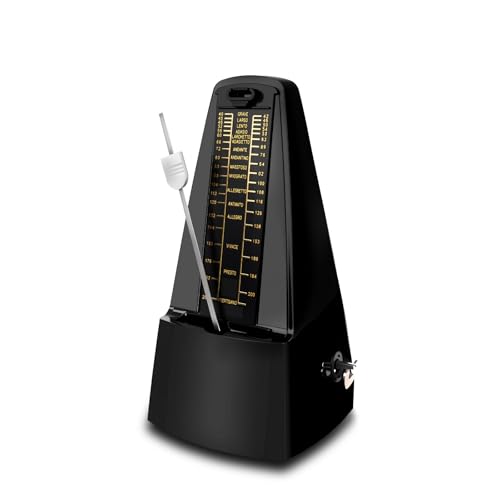
Defabee Mechanical Metronome with Loud Sound
- Top tempo not stated in the listing
- Type: Mechanical
It earns Also Great with a loud, clear sound, a 40–208 BPM range and five beat settings for most instruments.
Who it suits
- Players who want a loud, clear beat for practice
- Players who want a wind-up metronome with no batteries
Skip it if
- You need a tempo above 208 beats per minute
- You need a tempo below 40 beats per minute
This mechanical metronome needs no batteries: remove the dust cover, pull out the bottom slot, slide the slider to set the tempo, wind the mainspring clockwise and release the pendulum hook. It offers five settings, 0, 2, 3, 4 and 6, with a tempo range of 40–208 beats per minute. It weighs 1.1 lb and suits violin, guitar, piano and more.
Side by side
| Product | Top tempo | Tuner built in | Rechargeable | Headphone output | Type | Weight | Warranty |
|---|---|---|---|---|---|---|---|
| Ulumac Aroma 3-in-1 Digital Metronome Tuner | 260 BPM | Yes | Not stated | Yes | Digital | 0.2 lb | 1-year |
| KLIQ MicroNome | 260 BPM | Not stated | Yes | Not stated | Digital | Not stated | Not stated |
| TERENCE Mechanical Metronome | Not stated | Not stated | Not stated | Not stated | Mechanical | Not stated | 1-year |
| Sondery Mechanical Metronome with Bell for Piano | 208 BPM | Not stated | Not stated | Not stated | Mechanical | Not stated | Not stated |
| Defabee Mechanical Metronome with Loud Sound | Not stated | Not stated | Not stated | Not stated | Mechanical | 1.1 lb | Not stated |
How we ranked these metronomes
Every pick ranks in Amazon's best-seller list for its category and has a listing with real specifications. The order mixes two things: how each model compares on the specs below (higher share of the best value in this group scores more), and how widely it is bought. The spec score runs from 9.0 to 9.8 and only compares these picks with each other. A spec the listing does not state is left out and the other specs are re-weighted; a listing with fewer than 2 stated specs is scored at half. We do not test gear in person. Full method.
- Top tempo weight 1
- Tuner built in weight 1
- Rechargeable weight 1
- Headphone output weight 1
Buying advice: accurate metronome
Match the top tempo to your practice
Tempo range decides how far a metronome stretches. The Ulumac and the KLIQ both reach 260 BPM, while the TERENCE, the Sondery and the Defabee stop at 208 BPM. If the pieces you play stay between 40 and 208 BPM, any of the five works. If you practice faster passages, the two digital picks give the extra range. Check the top tempo in your current pieces before choosing.
Choose digital features or a wind-up build
Digital metronomes add features a wind-up build cannot. The Ulumac adds a chromatic tuner and a tone generator, and the KLIQ adds a rechargeable battery with 16 hours of use on one charge. The three mechanical picks need no batteries at all: wind the spring and the beat keeps going. A tuner matters if you tune between pieces; a wind-up build matters if you never want to charge or replace a battery.
Check beat patterns and rhythm settings
Beat patterns set how the metronome marks each bar. The Ulumac offers 10 beat patterns from 0–9 and 8 rhythm styles, and the KLIQ offers beats from 0–9 with 9 rhythm settings. The three mechanical picks offer 0, 2, 3, 4 and 6 beats. The Sondery links those beat choices to 2/4, 3/4, 4/4 and 6/8 time signatures. Match the beat choices to the time signatures in your music before choosing.
Frequently asked questions
What tempo range do I need in a metronome?
The Ulumac and the KLIQ reach 260 BPM, while the TERENCE, the Sondery and the Defabee reach 208 BPM. Check the top tempo in your pieces and pick a metronome that covers it.
Do I need a tuner built into my metronome?
Only the Ulumac has a built-in chromatic tuner, with a range of A0–C8 and ±0.5 cent accuracy. If you want tuning in the same unit, the Ulumac is the pick here.
Are mechanical metronomes accurate enough for practice?
The TERENCE uses a non-metal movement for accuracy, and the Sondery movement holds a tempo tolerance of less than 1%. Both run on a wind-up spring with no batteries. The Defabee gives precise beats with a loud, clear sound.
Can I practice quietly with these metronomes?
The Ulumac has a headphone jack and adjustable volume for quiet practice, and the KLIQ has digital volume control and a speaker. The Sondery has a sound-proof clockwork box that quiets tiny noises from the spring.
Gear that goes with it
 Best Wooden Music StandTop pick: Gator Frameworks Wooden Sheet Music Stand Designed
 Best Practice PadTop pick: Vhffoso 12 Inch Practice Drum Pad with Stand
 Best TrumpetTop pick: Eastar ETR-390 Standard B Flat Trumpet
 Best ClarinetTop pick: VANPHY Bb Clarinet 17 Keys Flat B Clarinet
More metronomes guides
Specifications and availability come from each Amazon listing on Nov 10, 2026 and can change. Check the listing before you buy.